Should I refinance my car before buying a home?

Short answer: probably not.

Why? The refinance of the car will impact your credit score as if you have purchased a new car. Credit scoring favors established older debt over new debt. Once you have that new loan, even if the payment is lower and interest rate is lower, the established old debt is paid off and eventually loses the positive impact to your credit scores.

[Read more…]

Fannie Mae and Freddie Mac improve HARP 2.0 Underwriting Guidelines

On Friday, Fannie Mae and Freddie Mac announced much needed updates to underwriting guidelines for HARP 2.0. The Home Affordable Refinance Program (HARP 2.0) has helped many Washington state homeowners with conforming mortgages (securitized by Fannie Mae or Freddie Mac prior to June 1, 2009) take advantage of historically low mortgage rates regardless of their home’s current equity (or lack thereof). You can learn more about the HARP 2.0 program by clicking here.

The recent updates to HARP 2.0 will allow more home owners to have access to this program by reducing documentation requirements for some borrowers. Here are some of the improvements:

  • Reduced documentation for income and assets. NOTE: Form 4506 and verification of employment will still be required. Lenders will not be required to verify large deposits.
  • Allowing borrowers with assets to not have to document income. This is available when a home owner has at least 12 months of their proposed new mortgage payment (PITI) in savings. The assets may come from checking or savings, stocks or vested retirement accounts.
  • Improvements to when a borrower is removed from the mortgage. Previously if a borrower was being removed with the HARP 2.0 refinance, guidelines required proof that the remaining borrower made the mortgage payments for the last year with their own separate funds (except in the case of death). Now with HARP 2.0, in the remaining borrower can qualify on their own (debt to income at 45% or lower and credit scores of 620 or higher) they may qualify for a HARP 2.0 refinance.

Remember, banks and lenders may layer their own underwriting guidelines to Fannie Mae and Freddie Mac’s HARP 2.0 program.

If you have been turned down for a HARP 2.0 refinance before, it may be worth checking with your local, licensed mortgage originator to see if you are now eligible. HARP 2.0 is available for owner occupied, vacation homes and investment properties.  I can help you if your home is located anywhere in Washington State – click here for your HARP 2.0 rate quote.

Mortgage rate update for the week of September 17, 2012

Last week the Fed announced they’re stepping up their purchase of mortgage backed securities to help keep mortgage rates low. While they are doing this, the FHFA (oversees Fannie Mae and Freddie Mac) is increasing the cost of conforming mortgages by increasing the “g-fees”. I’m seeing banks and lenders increasing rates from 0.25 to 0.50 in fee (the cost for a certain rate) and up to 0.625% more with extension fees (when your loan does not close in time). 

My advice with mortgage rates tends to be that if you like the rate, you should consider locking it. When it comes to locking rates, do a “gut check”. If you’re more uncomfortable with having a certain rate secured (locked) while rates may improve or if you can stomach not being locked and having mortgage rates increase. 

Here is a list of some of the economic indicators scheduled to be released this week:

Monday, Sept. 17: Empire State Index

Wednesday, Sept 19: Building Permits, Housing Starts and Existing Home Sales

Friday, Sept. 21: Initial Jobless Claims and Philadelphia Fed Index

As I write this post (9/17/12 at 8:45am PST) I’m quoting 3.500% for a 30 year fixed based on a loan amount of $400,000 with a sales price of $500,000 (80% loan to value). Seattle area home buyer has credit scores of 740 or higher and the purchase is closing by October 25, 2012. (apr 3.566) with closing cost estimated at $3525 and a principal and interest payment of $1,166.67 (taxes and insurance are not waived).

If you would like me to provide you with a mortgage rate quote on a home located anywhere in Washington, please contact me.

How can a preapproval change?

MortgageWhen someone becomes “preapproved” for a mortgage, it boils down to they qualify for a certain mortgage payment based on their income and debts (DTI aka debt to income ratio).  A home buyer qualifies for the loan amount of the new mortgage and their funds available for down payment and closing cost determine the sales price.

[Read more…]

The Fed Says…Let’s Twist

No surprise that the FOMC is not making any changes to the Fed Funds rate. What may have surprised some is the Fed’s focus on trying to keep mortgage rates low with it’s purchase of mortgage backed securities.  From today’s press release:

To support a stronger economic recovery and to help ensure that inflation, over time, is at the rate most consistent with its dual mandate, the Committee agreed today to increase policy accommodation by purchasing additional agency mortgage-backed securities at a pace of $40 billion per month. The Committee also will continue through the end of the year its program to extend the average maturity of its holdings of securities as announced in June, and it is maintaining its existing policy of reinvesting principal payments from its holdings of agency debt and agency mortgage-backed securities in agency mortgage-backed securities. These actions, which together will increase the Committee’s holdings of longer-term securities by about $85 billion each month through the end of the year, should put downward pressure on longer-term interest rates, support mortgage markets, and help to make broader financial conditions more accommodative.

….If the outlook for the labor market does not improve substantially, the Committee will continue its purchases of agency mortgage-backed securities….

The efforts to keep mortgage rates low will be in contrast to the increase in the “g-fees” by Fannie Mae and Freddie Mac. It will be interesting to see how much of an impact the Feds efforts will make.

Stay tuned for Ben Bernanke’s press conference happening in a few hours. Meanwhile… let’s twist!

Major Bank Jacks up the Cost to Extend Rate Locks

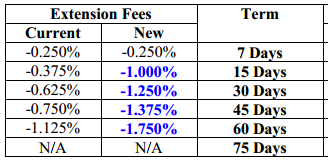
When a mortgage rate is locked, it’s committed for a certain period of times, such as 30, 45 or 60 days. When a mortgage refi or purchase that has been locked does not close by that date, the lender may charge a fee to extend.  The fee is essentially the cost to buy additional days to add to the original lock commitment. 

I just received this notice from one of the lenders we work with that they’re dramatically increasing their extension fees and, even worse, they’re only giving us ONE DAY’S NOTICE!  Kind of stinky if you ask me. This is the same bank that increased their fees just over a month ago.  The bank is doing this as a result of the 0.10% increase to G-Fees by Fannie Mae and Freddie Mac.

Extension Fees 001

Thankfully we work with several lenders and we’re not limited to only working with this bank.

More often than not, it’s better to error on having a longer lock period than a shorter one and paying for an extension.

UPDATE: Another bank just announced they are increasing their pricing by 0.500% basis points to their rates (not extension) as a result of the “G Fees”.

What may impact mortgage rates the week of September 10, 2012

Although at first glance, this week may seem like there’s not a lot scheduled that may impact mortgage rates, what is scheduled is significant. We have the FOMC meeting winding up on Thursday following last Friday’s weaker than expected Jobs Report. Friday is packed with reports that may reveal signs of inflation, which tends to drive mortgage rates higher. 

Here are some of the economic indicators scheduled for this week:

Thursday, Sept. 13:  FOMC Meeting; Producer Price Index (PPI); Initial Jobless Claims

Friday, Sept. 14: Retail Sales; Consumer Price Index (CPI); Consumer Sentiment Index (UoM)

For your personal mortgage rate quote for your home located anywhere in Washington state, please contact me.  

You can also follow me on Twitter or Facebook where I provide live rate quotes and mortgage tid-bits throughout the day.

Extension Fees 001
Extension Fees 001

FHA Rate-Term Refi’s may be a Great Option for Higher Loan Amounts

I have been working with a couple of Seattle area home owners who either have a jumbo mortgage or have a mortgage that used to be “high balance conforming” and were caught “in the gap” when conforming high balance loan limits were rolled back to $506,000 in King County.  A jumbo (aka non-conforming) mortgage is a loan amount over $506,000 in King, Pierce or Snohomish counties for a single family dwelling.

Jumbo mortgages typically require an 80% loan to value for a refinance. This can also cause a challenge if the home has lost equity and the values are “underwater” or above an 80% loan to value. Homeowners with an existing Jumbo mortgage do not qualify for HARP 2.0 since their existing mortgage is not securitized by Fannie Mae or Freddie Mac. Homeowners who have a High Balance Conforming mortgage from prior to to loan limit roll back may qualify for HARP 2.0 – however, their loan limit will be restricted to the current levels ($506,000 in King, Pierce and Snohomish counties) causing them to have to bring “cash in” to close.

One client, let’s call him “Mike in Magnolia”, has a jumbo mortgage at 6.500% with a balance of $640,000 and estimates the value of his Seattle area home to be around $600,000.  He’s really like to refinance and take advantage of the current low mortgage rates.  

One option would be an FHA jumbo which would allow a loan amount up to $567,500. Based on this scenario and pricing as of 1:30pm 9/6/12, his rate would be 3.500% for a 30 year fixed (apr 4.382). This would provide him a PIMI (principal, interest and mortgage insurance) payment of $3,155.46 and cash for closing would be around $78,000. His home could appraise for as low as $585,000 and still have this scenario work at an 97.75% loan to value.

If Mike is willing to bring $142,000 to closing, he could consider a conventional refinance at $506,000. His home would need to appraise for around $600,000. Based on current rates of 3.875% for a 30 year fixed (apr 4.117); his PIMI payment would be $2640.83. His home would need to appraise for at least $600,000 for an 85% loan to value.

I’m working with another client who has a condo in downtown Seattle that has lost value. They obtained their mortgage after May 31, 2009, so it does not qualify for HARP 2.0. The condo IS on HUD’s approved list for FHA financing which will allow them to take advantage of today’s lower FHA mortgage rates with a loan to value of up to 97.75%.

FHA rate-term refinances are a “full doc” loan and will require an appraisal.  FHA mortgages may be assumable to a qualified buyer should these clients decide to sell their homes in the future.

If you’re interested in an FHA mortgage or having me review your scenario for your home located anywhere in Washington state, please contact me.