2010 Conforming Loan Limits for Washington State

Fannie Mae along with FHFA have announced that the 2010 conforming loan limits will be the same as 2009.   FHA's 2010 loan limits will follow from HUD:

However, as noted in FHFA's announcement, high-cost area loan limits are derived from median home prices estimated by the Department of Housing and Urban Development (HUD).  HUD has a 30 day appeals period where requests for indiviual area median home price increases are evaluated.  FHFA will issue a subsequent announcement if any invididual high-cost area loan limit is increased as a result of HUD's apppeals process.

Conforming Loan Limits for 2010

1 Unit – $417,000

2 Unit – $533,850

3 Unit – $645,300

4 Unit – $801,950

NOTE:  The following Washington counties do not have "high-cost area loan limits": Adams, Asotin, Benton, Chelan, Clallam, Columbia, Cowlitz, Douglas, Ferry, Franklin, Garfield, Grant, Grays Harbor, Island, Kittitas, Klickitat, Lewis, Lincoln, Mason, Okanogan, Pacific, Pend Oreille, Spokane, Stevens, Thurston, Wahkiakum, Walla Walla, Whatcom, Whitman and Yakima.

High Balance Loan Limits for Washington State

King, Pierce and Snohomish Counties

1 Unit – $567,500

2 Unit – $726,500

3 Unit – $878,150

4 Unit – $1,091,350

Clark and Skamania Counties

1 Unit – $418,750

2 Unit – $536,050

3 Unit – $648,000

4 Unit – $805,300

Jefferson County

1 Unit – $437,500

2 Unit – $560,050

3 Unit – $677,000

4 Unit – $841,350

Kitsap County

1 Unit – $475,000

2 Unit – $608,100

3 Unit – $735,050

4 Unit – $913,450

San Juan County

1 Unit – $593,750

2 Unit – $760,100

3 Unit – $918,800

4 Unit – $1,141,850

Fannie Mae also announced a loan limit for second mortgages:

For second mortgage loans, the loan limit for 2010 is $208,500…. Furthermore, the sum of the original loan amounts of the first and second mortgage loans may not exceed the applicable loan limit for first mortgage loans based on the location and the number of units of the subject property. These loan limits apply whether or not Fannie Mae owns or has an interest in the first mortgage loan.

When I began my mortgage career back in 2000, the conforming loan limit for a single family dwelling was $252,700. 

Good Faith Estimate Part 3: Escrow Account Information

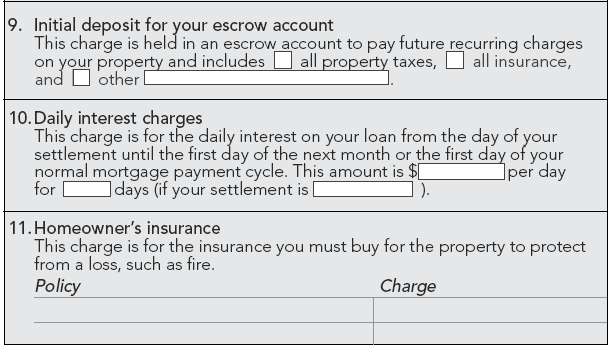
This next section of HUD's new Good Faith Estimate covers the escrow account, also known as the reserve account. (Click the graphics for a larger picture).

GFEEscrow

According to HUD's New RESPA FAQs, the block you see above does not include the taxes or insurance (the escrow/reserves portion of the payment). 

"…the first block is for the monthly amount that will be owed for principal, interest and mortgage insurance only.  Additional information on charges relating to the escrow account is in Block 9 on page 2 of the GFE."

This section primarily addresses whether or not there is an escrow reserve account.  Borrowers may elect to waive their reserve account when they have conventional finanancing and at least 20% equity in their home.  Most lenders charge a fee of 0.25% of the loan amount should a borrower elect to pay their own taxes and insurance.   Having an escrow reserve account when a home owner has enough home equity is generally not "required" as stated on the new GFE, however the home owner will receive either a slightly better rate or lower cost opting to have taxes and insurance included in their payment.

Hop on over to "Your Charges for All Other Settlement Services on page 2, Boxes 9 – 11 of the GFE to see how much will be collected to initiate your escrow reserves (boxes 9 and 11) account and prepaid interest (box 10).

GFEreservespp

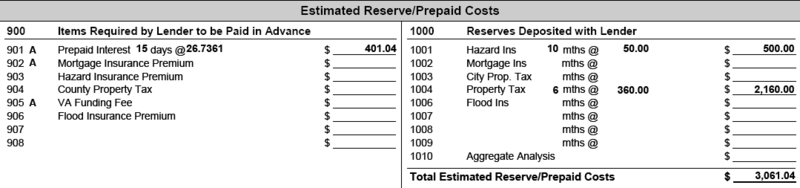
Our current good faith estimate (below) shows the escrow reserve account with a detailed account of how many months of taxes and insurance are due verses the dumbed down lumped version of the new GFE.

GoumazReservesPP

The current (soon to be retired) GFE includes taxes and insurance in the mortgage payment–even if the borrower has elected to waive the reserve account (pay taxes and insurance on their own) since borrowers are qualified based on the entire mortgage payment due (principal, interest, taxes and insurance).

Is this easier to understand so far? I don't think so…but I would love to hear from you.

More Upcoming Changes to Underwriting

I originally wrote this post at Rain City Guide back in June of this year.  Fannie Maes tougher guidelines will go into effect in just a few days on September 1, 2009.  You can read the original post and comments by clicking here. 

Fannie Mae issued Announcement 09-19 amending some very basic underwriting guidelines that will not only impact conventional financing; it will apply to FHA insured loans that are underwriting using Fannie Mae’s DU.   You can read the entire announcement by clicking  here.

Here are some of the changes:

  • Credit documents will be valid for 90 days instead of the current 120 for existing construction.   The age of the document is measured from the date of the document to the date the Note is signed.
  • IRS Forms 4506 or 4506-T is required at application and at closing.  This is due to fraud (misrepresentation of income).
  • Age of appraisal is reduced from 6 months to 4 months.
  • Trailing Secondary Wage Earner Income is eliminated.   Now with a relocation, only the income of the spouse with actual employment may be considered.  Previously, it was possible to use the relocating spouse’s income from their employment prior to the relo without having an actual job.
  • Verbal Verification of Employment required within 10 days of signing the Note for employment income and within 30 days for self-employed income.  (Our company has always performed a verbal VOE prior to funding).
  • Stocks, bonds and mutual funds now valued at 70% instead of 100% to be used as reserves.   Due to market volatility, Fannie Mae is devaluing your portfolio.   This means that if you provide your mortgage originator with a stock, bond or mutual fund statement showing an ending balance of $10,000; the figure used for qualifying and on the application will be $7,000 (70% of the value).   Stock options and non-vested restricted stocks are no longer eligible to use as reserves.
  • Retirement accounts valued at 60% instead of 70% to be used as reserves.  

Fannie Mae’s effective dates are to follow…if the loan is manually underwritten, this applies to applications dated on or after September 1, 2009.   However, expect to see lenders and banks to adopt these guidelines early.

Making Home Affordable Refinance – Can I Help You? Maybe…Maybe Not.

UPDATE JUNE 19, 2010:  The Home Affordable Refinance Program has become much easier to do since writing this post with both Fannie Mae and Freddie Mac securitized mortgages.  This post is pretty outdated (the hazards of writing about mortgages on a blog!)  If you need help with refinancing your home in Washington, please contact me.

Here is an updated information on Fannie Mae's Home Affordable Refi.

NOTE:  This program is still "evolving". Wholesale lenders/banks and private mortgage insurance companies are still issuing and revising their guidelines.  I'll try to update this post with current information as I receive it.

Fannie Mae will be implementing the Making Home Affordable Refi starting April 4, 2009.  Some home owners will be free to use any mortgage professional (as long as they are Fannie Mae approved) and others will be forced to return to their mortgage servicer.

First of all, I am only licensed to provide residential mortgages for homes located in Washington State.

UPDATE: IF YOUR MORTGAGE IS OWNED BY FREDDIE MAC, I MAY BE ABLE TO HELP YOU.  YOU DO NOT HAVE TO GO TO YOUR MORTGAGE SERVICER (WHO YOU MAKE YOUR PAYMENTS TO).

Currently, for the Home Affordable Refinance, Freddie Mac is requiring that home owners return to their mortgage servicer.  To determine if your mortgage is owned by Freddie Mac, click here. If your mortgage is owned by Freddie Mac, I probably cannot help you with an Making Home Affordable refinance.   However if your current mortgage is owned by Freddie Mac and you have home equity (you're not upside down); I may be able to help you.   Fannie Mae has a larger market-share than Freddie Mac…odds are in your favor, but check Freddie Mac first.  UPDATE:  Since writing this post, one major bank has informed us they will allow us to originate Home Affordable/Freddie Mac mortgages as long as we broker the loan back to them

If your mortgage is not owned by Freddie Mac, the next step is to see if it's owned by Fannie Mae. You can determine that by clicking here.   Unlike Freddie Mac, Fannie Mae is allowing home owners to use eligible mortgage brokers, bankers and correspondent lenders of their choice.  If your mortgage is owned by Fannie Mae (and your home is in WA); I may be able to assist you with your Home Affordable refinance.

Here are some important pointers about Fannie Mae's Home Affordable refinance (homes at a higher loan to value):

  • Second mortgages must be subordinated.  They may not be included (paid off) with the home affordable refinance.
  • Borrowers on the existing mortgage must match the new mortgage.  Borrowers may be added but they may not be removed.   UPDATE:  Borrowers can be removed under certain circumstances.
  • If a borrower currently has lender paid mortgage insurance (a slightly higher rate that financed private mortgage insurance) they may have to return to their mortgage servicer (who they make their mortgage payments to) for a Home Affordable refinance.  

What if your existing mortgage is FHA or VA?  You may qualify for a FHA or VA Streamline refinance which may not require an appraisal or income verification (you will need a mid-credit score of 620 or higher).

Lenders are currently inundated with refinance and purchase business due to the current low mortgage rates.   I encourage you to apply early and be very patient.   Washington State home owners can apply using my secure on-line application under "Favorite Links".

The bottom line is, if your home is in Washington I can at the very least help point you in the right direction and at the most, I can help you with your new refinance.

Revised 2009 Conforming Loan Limits for Washington State

Conforming loan limits are tiered with some areas qualifying as "high cost" and provided a second level before being considered a "jumbo" loan.  Today, FHFA announced the new limits aka "Conforming High Balance" or "Agency Jumbo".

King, Pierce and Snohomish Counties

$567,500 – 1 Unit

$726,500 – 2 Unit

$878,150 – 3 Unit

$1,091,350 – 4 Unit

Jefferson County

$437,500 – 1 Unit

$560,500 – 2 Unit

$677,000  – 3 Unit

$841,350 – 4 Unit

Kitsap County

$475,000 – 1 Unit

$608,100 – 2 Unit

$735,050 – 3 Unit

$913,450 – 4 Unit

San Juan County

$593,750 – 1 Unit

$760,100 – 2 Unit

$918,800 – 3 Unit

$1,141,850 – 4 Unit

Skamania and Clark Counties

$418,750 – 1 Unit

$536,050 – 2 Unit

$648,000 – 3 Unit

$805,300 – 4 Unit

Conforming loan limits (true) and for all other Washington counties not listed above:

$417,000 – 1 Unit

$533,850 – 2 Unit

$645,300 – 3 Unit

$801,950 – 4 Unit


Upside down in your home with good credit? March 4, 2009 may be an important date for you.

Just received this email, which I'm sure echos the thoughts of many home owners:

"Been meaning to contact you to get your take on the recent wholesale changes that are coming hard and fast at the mortgage bankers out there and, of course, see if there can be any benefit to a re-fi given the new lending "rules" (for lack of a better term). We're horribly upside-down on our current loan balance vs. current home value, so we don't know what can happen for us, if anything. But if there's a way to get that rate down and send out less each month. we're listening! What do you think about all this?"

Last week, President Obama announced his plans to help stimulate the economy and help provide stability with America's housing.  With the Homeowner Affordibility and Stability Plan, home owners who are "credit worthy" may be able to refinance their home up to 105% loan to value

On March 4, 2009, more details are suppose to be announced.  Here's what we understand so far:

  • The program is limited to loans held or securitized by Fannie Mae or Freddie Mac.
  • First mortgage may not be more than 105% of the value of the property. 

  • Borrowers with a second mortgage may still be able to refinance if the second mortgage lien holder is willing to remain in second lien position and if the borrower still qualifies.

  • The program will offer 30 year or 15 year fixed interest rates based on market rates.

  • The program only applies to the home you live in.  It does not apply towards vacation or second homes or investment properties.

According the the Treasury, this program will not be available until March 4, 2009.  Lenders will become even more buried with refinance business once this happens.  It is to your advantage to be prepared.  By gathering the following information:

  • 2008 W2s (if self employed or paid commission, 2 years of complete tax returns)
  • Most recent paystubs covering 30 days of income.
  • Most recent mortgage statements.

  • Information on current monthly debts including amount paid monthly and amount owed.

  • Most recent bank statements/asset accounts (all pages).

If your home is located in Washington State, you can apply on line now by clicking the link under my photo.  However, I don't anticipate having more details until March 4, 2009.

More to follow.

Fannie Mae: The Hits to Rate Keep Coming

Fannie Mae has announced new "hits to rate" that will take place on mortgages they purchase effective April 1, 2009.  This means that lenders will start to implement these increases ANY TIME since loans originated today may be bought by Fannie around the effective date for the new increased pricing.  No lender wants to be an April Fool and in position of having to make up for the difference in price when the loan is sold. 

Below is an example of some of the hits to pricing rates.  You can see why Mortgage Professionals should not rattle off rate quotes without having detailed information of the borrower.  If a couple (or single borrower) has a low-mid credit score of 720-739 and they are putting 20% down (LTV 75.01-80%) they can pay 0.25% more in fee than a borrower with a 740+ mid score or the 0.25% will be factored into the interest rate (currently running about 0.125% to rate).

Agency Products 

LTV
LTV
LTV
LTV
LTV
LTV
LTV
FICO
<=60%
60.01-70%
70.01-75%
75.01-80%
80.01-85%
85.01-95
>95%
>=740
+0.25
0.00
0.00
0.00
0.00
0.00
0.00
720-739
+0.25
0.00
0.00
-0.25
0.00
0.00
0.00
700-719
+0.25
-0.50
-0.50
-0.75
-0.50
-0.50
-0.50
680-699
0.00
-0.50
-1.00
-1.50
-1.00
-0.75
-0.50
660-679
0.00
-1.00
-2.00
-2.50
-2.25
-1.75
-1.25
640-659
-0.50
-1.25
-2.50
-3.00
-2.75
-2.25
-1.75
620-639
-0.50
-1.50
-3.00
-3.00
-3.00
-2.75
-2.50
<620
-0.50
-1.50
-3.00
-3.00
-3.00
-3.00
-3.00

Cash-Out Refinance

LTV
LTV
LTV
LTV
LTV
LTV
LTV
FICO
<=60%
60.01-70%
70.01-75%
75.01-80%
80.01-85%
85.01-90%
>90%
>=740
0.00
-0.25
-0.25
-0.50
-0.625
-0.625
N/A
700-739
0.00
-0.625
-0.625
-0.75
-1.50
-1.00
N/A
680-699
0.00
-0.75
-0.75
-1.375
-2.50
-2.00
N/A
660-679
-0.25
-0.75
-0.75
-1.50
-2.50
-2.00
N/A
640-659
-0.25
-1.25
-1.25
-2.25
-3.00
-2.50
N/A
620-639
-0.25
-1.25
-1.25
-2.75
-3.00
-2.50
N/A
<620
-1.25
-2.25
-2.25
-2.75
-3.00
-3.00
N/A

Condominium and Cooperative Property Types

Adjustment Name
Old Adjustment
New Adjustment
LTV >75%
N/A
-0.75

Here are the current (soon to be former) price adjustments from Fannie.

Fannie and Freddie Suspend Foreclosures

Statement from FHFA James B. Lockhart:

“The foreclosure suspension announced today by Fannie Mae and Freddie Mac will help homeowners and servicers utilize the new streamlined loan modification program (SMP) announced by FHFA, Fannie Mae, Freddie Mac and HOPE Now. With this suspension, seriously delinquent borrowers may have an opportunity to avoid foreclosure and work out terms to stay in their homes.”

According to Fannie Mae’s press release, this suspension will take place from November 26, 2008 – January 9, 2008 for owner occupied, single family dwellings for home owners who have not filed for bankruptcy and who has missed three or more payments.

Related Post: Fannie and Freddie’s New Deal