Some links have been moved and I'm now using Video-email….check it out!
Helping Washington State homeowners learn more about their mortgage options.
Some links have been moved and I'm now using Video-email….check it out!
With this morning's snow and potentially more on the way, it's funny to think about Spring with our wacky weather. I remember hearing one of my neices last year refer to our Spring as Swinter. Let's hope it's not like last year…I'm ready for a "real" Spring…and so are my Bleeding Hearts.

Don't forget to "Spring Forward" and set your clocks ahead one hour before you to sleep tonight.
UPDATE: The Home Affordable Program has changed quite a bit over this past year. Please contact me if you're interested in reviewing your scenario on your home located in Washington State.
More details to President Obama's Making Home Affordable Refinance and Modification Options that was unveiled yesterday. Fannie Mae issued an announcement that they will be able to purchase refinances under this plan on April 1, 2009. This means that lenders will be able to start originating these loans now. Homeowners with mortgages who are interested in refinancing or a loan modification fall into a couple different categories.
If you have equity in your home and you qualify for a refinance, you do not need this program. The Making Home Affordable Refinance does not allow cash-out–this would be a standard refinance which is still available.
You may be eligible for a Making Home Affordable Refinance if:
If you meet the above conditions for a refinance or Making Home Affordable Refinance, contact your local mortgage professional. Details about how the home affordable refinances will be priced have not yet been announced. Currently Fannie and Freddie have price hits based on loan to value and credit scores.
If your home is located in Washington State, I'm happy to help you with any type of residential mortgage. You can begin the process by completing a loan application which I have on line under my photo (to the left) under favorite links. Be prepared to provide the following:
Refinances are most likely taking longer than the last time you obtained a mortgage due to the volume of business during a time when every aspect of the mortgage and real estate industry has fewer people employed. Please be patient.
With home values depreciating in most areas, I do not recommend delaying your refinance. The higher your loan to value (mortgage balance divided by home value), the more challenging the transaction will be.
**If you own a home and are having a difficult time making your mortgage payment because you have less income or your payment has increased and if you do not qualify for a refinance; you're probably in the loan modification camp. Start today with contacting who you make your mortgage payments to (the loan servicer). You can also call HOPE NOW at 1-888-995-HOPE (4673). You do not need to pay someone (a loan mod "specialist") to assist with modifying your mortgage.
Loan modifications are available through the Making Home Affordable Modification program if you are at risk of "imminent default" or currently delinquent on your mortgage payment. Your servicer may or may not decide to modify your mortgage–there are no guarantees but you must take action now. Click here for more information about the Making Home Affordable Modification.
As promised, this morning some of the details have been announced from the Treasury regarding the plans to help responsible home owners via refinancing or loan modifications in the "Making Home Affordable Program". From this mornings Press Release:
"Today, we are providing servicers with the details they need to begin helping eligible borrowers," said Treasury Secretary Tim Geithner.
The Making Home Affordable program addresses refinancing existing mortgages and loan modifications. From the summary of guidelines:
The Home Affordable Refinance program will be available to 4 to 5 million homeowners who have a solid payment history on an existing mortgage owned by Fannie Mae or Freddie Mac. Normally, these borrowers would be unable to refinance because their homes have lost value, pushing their current loan-to-value ratios above 80%. Under the Home Affordable Refinance program, many of them will now be eligible to refinance their loan to take advantage of today’s lower mortgage rates or to refinance an adjustable-rate mortgage into a more stable mortgage, such as a 30-year fixed rate loan.
GSE lenders and servicers already have much of the borrower’s information on file, so documentation requirements are not likely to be burdensome. In addition, in some cases an appraisal will not be necessary. This flexibility will make the refinance quicker and less costly for both borrowers and lenders. The Home Affordable Refinance program ends in June 2010.
Update 11:00 am: this program should be available in April. Fannie and Freddie have to implement the new guidelines into their system before lenders have ability to provide refinances over 80% loan to value without private mortgage insurance. More information will follow as it becomes available. Get your loan application in now!
The Home Affordable Modification program does not involve a refinance (which is a new mortgage replacing the existing mortgage). With a loan modification, the terms of the existing mortgage are modified. You can read the borrower qualifications by clicking here. This applies to borrowers who are dealing with "financial hardship" and this is a "full document" transaction including providing income documentation and verification that the home is owner occupied. Families with high debt levels may be required to complete financal counceling through a HUD approved counselor.
This program factors in the High Cost areas, like Seattle, Bellevue, Tacoma and Everett. The newly revised High Balance loan limit for our area is $567,500. Which it looks like as of today, may actually be available.
Treasury announced today that the Making Home Affordable program will also include additional incentives for efforts made to extinguish second liens on loans modified under this program.
In an effort to keep mortgage rates low, the Treasury is also stepping up its Preferred Stock Purchase Agreements to $200 billion each (to Fannie and Freddie) from $100 billion. These funds are coming from the Housing and Economic Recovery Act and are not a part of TARP.
If the Government really wants to reduce mortgage rates, they should look at suspending some of Fannie Mae and Freddie Macs price hits (LLPA) which are not working "in concert" with the efforts of the Treasury.
There is certain a lot of "efforts" being made by our Government. The next step is to have the Fannie and Freddie implement these plans AND THEN it trickles down to the banks. We'll see how quickly this process will be.
If you're considering taking advantage of the historic low rates and you're not quite ready to commit to working with a Mortgage Professional, I suggest you watch this short presentation. I'll share a few tips to help you gauge which direction rates are trending and when you're ready, I'm happy to do the rate watching for you.
My Mortgage Consulting services are only available for residential property located in Washington State.
Please visit or up-to-date FHA Guide for current FHA loan limits for homes located in Washington state. [Read more…]
Conforming loan limits are tiered with some areas qualifying as "high cost" and provided a second level before being considered a "jumbo" loan. Today, FHFA announced the new limits aka "Conforming High Balance" or "Agency Jumbo".
King, Pierce and Snohomish Counties
$567,500 – 1 Unit
$726,500 – 2 Unit
$878,150 – 3 Unit
$1,091,350 – 4 Unit
Jefferson County
$437,500 – 1 Unit
$560,500 – 2 Unit
$677,000 – 3 Unit
$841,350 – 4 Unit
Kitsap County
$475,000 – 1 Unit
$608,100 – 2 Unit
$735,050 – 3 Unit
$913,450 – 4 Unit
San Juan County
$593,750 – 1 Unit
$760,100 – 2 Unit
$918,800 – 3 Unit
$1,141,850 – 4 Unit
Skamania and Clark Counties
$418,750 – 1 Unit
$536,050 – 2 Unit
$648,000 – 3 Unit
$805,300 – 4 Unit
Conforming loan limits (true) and for all other Washington counties not listed above:
$417,000 – 1 Unit
$533,850 – 2 Unit
$645,300 – 3 Unit
$801,950 – 4 Unit
Just received this email, which I'm sure echos the thoughts of many home owners:
"Been meaning to contact you to get your take on the recent wholesale changes that are coming hard and fast at the mortgage bankers out there and, of course, see if there can be any benefit to a re-fi given the new lending "rules" (for lack of a better term). We're horribly upside-down on our current loan balance vs. current home value, so we don't know what can happen for us, if anything. But if there's a way to get that rate down and send out less each month. we're listening! What do you think about all this?"
Last week, President Obama announced his plans to help stimulate the economy and help provide stability with America's housing. With the Homeowner Affordibility and Stability Plan, home owners who are "credit worthy" may be able to refinance their home up to 105% loan to value.
On March 4, 2009, more details are suppose to be announced. Here's what we understand so far:
First mortgage may not be more than 105% of the value of the property.
Borrowers with a second mortgage may still be able to refinance if the second mortgage lien holder is willing to remain in second lien position and if the borrower still qualifies.
The program will offer 30 year or 15 year fixed interest rates based on market rates.
The program only applies to the home you live in. It does not apply towards vacation or second homes or investment properties.
According the the Treasury, this program will not be available until March 4, 2009. Lenders will become even more buried with refinance business once this happens. It is to your advantage to be prepared. By gathering the following information:
Most recent mortgage statements.
Information on current monthly debts including amount paid monthly and amount owed.
Most recent bank statements/asset accounts (all pages).
If your home is located in Washington State, you can apply on line now by clicking the link under my photo. However, I don't anticipate having more details until March 4, 2009.
More to follow.
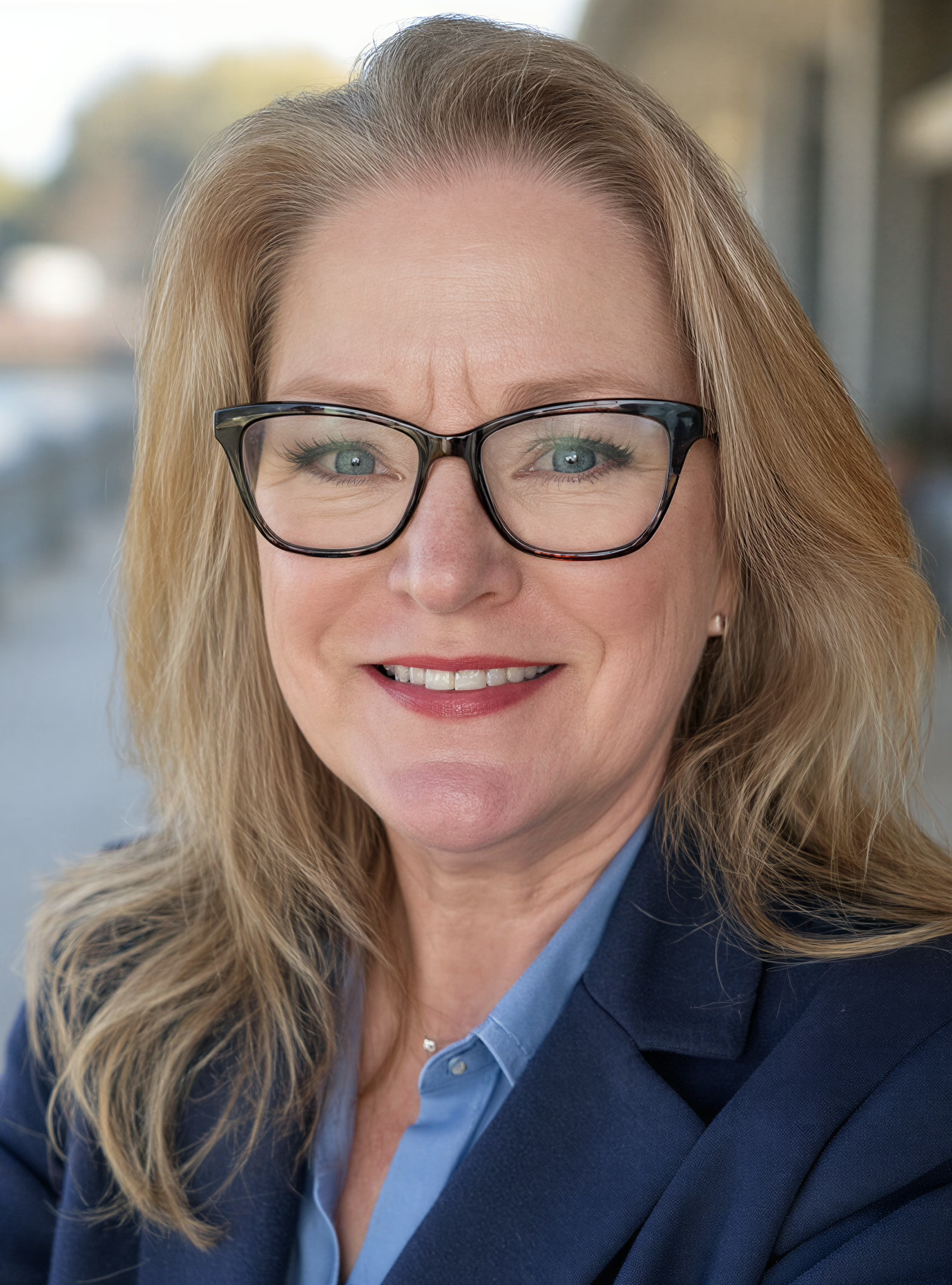 Rhonda Porter is a Licensed Mortgage Originator MLO121324 living in the greater Seattle area. Rhonda began her career in 1986 in the title and escrow industry and began her mortgage career in 2000. She enjoys helping people understand the mortgage process and started writing The Mortgage Porter in late 2006. Read More…





Recent Comments