Is My Preapproval Still Valid with all the Rate Changes?

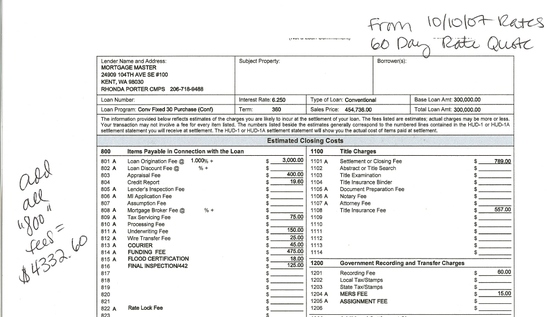
iStock-000018668640XSmallMy clients and readers ask such great questions…I just received this one from one of my clients that I’ve been working with since June of this year:

“…with all the rate changes how is our pre-approval looking? It the original amount still applicable?”


[Read more…]

Game plan for preparing to buy a home when you’re credit score is low

I don’t blame anyone for wanting to own a home.  Sometimes when I meet with clients and review their current scenario, a game plan needs to be created so they can work on getting themselves into a better position to buy a home.  The last thing anyone wants is to cram themselves into a mortgage they cannot afford or to commit to a long term payment when they don’t have a great track record of making payments on time. Some times a plan may take 6 months or a year or longer before someone is ready to buy a home.

I have someone with low credit scores who wants to buy a home.   She knows she will probably be a candidate for FHA financing because she has little down payment and her credit.  Although FHA is not as persnickety about credits scores as conventional financing, they scrutinize credit history: especially the last 12 months.

This person has a few late payments this year, the last one being as recent as August.  FHA financing is most likely out of the question for her until August next year assuming she does not make any other late payments between now and then. She can work on her credit for the next 10-12 months (until she has 12 months since her last late payment).   She doesn’t have any collections but she does have a few small accounts that are “maxed out”. 

  • Credit card “A” with a balance of $477 and a limit of $500.
  • Credit card “B” with a balance of $323 and a limit of $300.
  • Credit card “C” with a balance of $215 and a limit of $300.
  1. The first thing she should do is focus on getting card “B” under the limit of $300.  She’s getting whammo’d with her credit scores for being extended beyond what her credit limit is with this account (in addition to being maxed out).   She should at least pay it down enough to make sure that her interest fees won’t keep popping her over her limit.
  2. Next she should select one of her two smallest cards to pay down to at least just below 50% of her card limit.   Card “C” would only take about $65 to bring her debt down to 50% of the line limit (300 x 50% = $150).
  3. Then pay down the next card to at least 50% of the limit.  “Card B” will take $150 (assuming she’s paid the extra $23 that has pushed her over the limit) to be at 50% of the credit line limit.
  4. Credit card “A” will take a little extra cash at $227. (500 limit x 50% = $250.  477 – 250 = 227).

She needs to keep her credit below 50% of the credit line at the very minimum.  I know I said FHA is not as picky as conventional.  However, you do want your credit scores above 600 in order to receive better pricing (620 and higher is even better).

Not only will this help her with qualifying for FHA financing, she’s probably also paying higher insurance rates due to her current credit scores. 

She has a decent income and no savings.   She needs to use this time of working on her credit to also build up her reserves.  Not only for what the lender will require (3.5% minimum down payment for FHA as of January 1, 2009); but for her sake should her income change or issues arise, she should have a minimum of 6 months worth of living expenses saved (FHA does not require this, I’m suggesting it).

She has been considering homes priced around $275,000.  FHA’s minimum required investment for this home next year will be $9,625.  The seller can pay the remaining closing costs and prepaids as long as she has met the above requirement (which can be a gift or loan from family members)–this would need to be negotiated in the purchase and sale agreement. 

The proposed mortgage payment would be around $2,000 (including taxes, home owners insurance and mortgage insurance).  This is $700 more per month than what she is currently paying for rent.  Once she has corrected her credit, she should practice making a $2000 mortgage payment by paying the difference ($700) into a savings account that she leaves untouched for her down payment and to hopefully create a savings cushion.  $12,000 in savings would be ideal (6 months of mortgage payment) but not required.   If she has no savings, it will take her just over a year to pay $700 per month to come up with the down payment (9625 divided by 700 = 13.75).  Another 17 months to have a savings cushion of $12,000. 

I know this isn’t instant gratification.  It is developing responsible financial habits.  There are expenses to owning a home beyond renting.  One of my last homes required a new roof just months after moving in to the tune of $15,000.  Savings has always been important and it’s even more true in our current economy.

She’s all ready moving in the right direction by contacting a Mortgage Professional who is interested in her long term financial well-being and is willing to help her create a game plan.

Check out my related articleGetting on Track to Buy Your First Home

Can I buy a $620,000 home with a low credit score?

This morning I received this email:
My wife and I found a house we are in love with. I wanted to write and tell you our situation, maybe you can tell us if we are even in the "ballpark".    The house we like is 620,000. We have 20% to put down. We have very little debt and well documented income. I have a low credit score, 660 or lower. Is this worth pursuing or is the credit score too low?
Based on current guidelines/pricing, you really need to have your credit scores above 660 if you’re considering loan amounts above "true conforming" (presently $417,000). It’s very possible that this couple can buy a home utilizing an FHA jumbo mortgage which leans more towards credit history rather than credit score.  Here are some factors that would indicate whether or not this is a possibility for this couple:
  • Credit history.
  • Loan limits.

Unfortunately the loan limits where this couple are considering to purchase are much lower than what we have in the King County area.  They’re wanting to buy in Clark County which currently has a temporary jumbo limit of $418,750.   They would need about $200,000 for their down payment with the seller paying closing costs and prepaids (est. at $12,000).   Or they could opt for conforming financing with a loan amount of $417,000 and try to get a conventional approval (with a larger down payment, it’s possible).

If they were buying in King, Pierce or  Snohomish County, the loan limit is currently $567,500 and would have the option of putting less than 20% down (as low as 3.5%), should they wish assuming they qualify for the payment.

Regardless of where the property is located, the last 12 months of credit history is more critical than credit score (as long as the credit scores are 600 or higher) for a purchase using an FHA insured loan.

FHA loans are full doc and will need to be sourced and seasoned.  Buyers should be prepared to provide their last 2 years of W2s (and possibly tax returns) as well as at least 30 days of income on their paystubs.

Remember, we should be learning in early November what the new jumbo loan limits will be.  I’ll keep you posted!

Vesting: How to Take Title for Your Real Property

UPDATE 1/5/12: With First American Title absorbing The Talon Group, apparently they decided to take down many of the videos the talented crew at Talon created for consumers. Here is a pdf that contains information on vesting: Download Different Ways of Holding Title.

UPDATE 5/15/2013: Wow! It looks like this video is back… thanks, First Am!

If you are buying a home in Washington State, it’s important to consider how you are going to hold title (vesting), especially if you’re buying with another individual and you are unmarried.  Tim Daniels, Chief Title Office of The Talon Group, shares various ways people can consider for vesting of their real estate property.

Tips for homebuyers and sellers

Yesterday I was interviewed by Melinda Fulmer for a MSN Real Estate article.   Here were a few of my pointers (with some clarification) for buyers:

1.  Plan on having a down payment.  FHA allows for a reduced down payment which can be gifted or loaned by family members, as does USDA and VA. However I do like to see those shy on savings practice making mortgage payments to a savings account until they have at least 6 months of mortgage payments “in reserves”.   This account is not to be used for your down payment–it’s in case of an emergency.

2. Be picky when selecting your loan originator.  I do believe in getting referrals from people you financially respect.  You can also try “googling” their names to learn more about the loan originator and their qualifications.

Borrowers may be better off working with loan originators who have are able to provide FHA loans–even if they’re not considering FHA financing.  Many conventional loans are having to switch to FHA financing as the underwriting is more forgiving and rates may be better depending on mid-credit scores.

3. Get prequalified as soon as possible.  This is a good way to get to select your loan originator (this is not the same as a preapproval).  During this stage, you’ll be able to see how detailed oriented the LO is what their personality is like–what type of programs do they recommend.  A LO should provide you a Good Faith Estimate without any commitment from you.

4. Rate lock strategy.  Ask your LO what they can do if rates improve after you lock.  Right now, with the turbulent markets, many lenders are offering free rate float downs as long as the lock meets specific criteria.  This provides borrowers with the assurance that the rate will not be higher than the current rate lock and that should rates improve, they may have the opportunity to “float down” to that rate.  Do make sure to obtain a written lock confirmation.

For sellers, I suggest that they insist on a preapproval letter to be included with their offer.  They should also carefully read the letter, it should address the buyer’s credit, income/employment and where the down payment is coming from along with the type of loan they’re approved for. Preapproval letters are sadly not worth more than the paper they’re written on, however they can provide you with some clues about the lender the buyer is working with.  If a seller has two identical offers, the buyer’s lender can make a huge difference in whether or not the transaction closes smoothly.

What takes place between signing and closing?

What happens between signing documents and closing? Watch this video featuring The Talon Group’s Chief Title Officer, Tim Daniels as he explains what happens with your loan documents after you finish signing at the escrow company.

Declining Home Values: Good for Buyers – Bad for Refi’s

Last Wednesday’s Seattle PI featured a front page article by Aubrey Cohen: Home values drop by double digits.   According to data by the NWMLS, the median sales price for houses in August 2008 for Seattle was $464,800; a 7.8% drop from July 2008 of $428,500 and 14.5% drop when compared to the median sales price from August 2007 of $501,000.   King County also dealing with a double digit drop.   The median sales price for houses in King County in August 2008 was $423,950; a 4.7% drop in one month with July 2008 at $445,000 and a 11.2% drop compared to August 2007 at $447,345.

If you’re a home buyer in this market, you’re in the drivers seat…and sitting pretty at that.  Listings are up 18.3% in King County (condos and houses) as compared to August of 2007; giving you plenty of choices.  Sellers are more likely to contribute towards your closing costs and prices are more attractive than recent years.

What if you all ready own a home and you’re considering refinancing?  Even though your home is your castle, the appraiser must use 3 recent sales (over the last 6 months is preferred) of homes similar to yours to come up with an appraised value.  This can be a little tricky with fewer sales AND lower sales prices.   Using the King County figures above and rates I’ve quoted at Mortgage Porter, this is how a refinance could be impacted:

Joe and Suzy purchased their home in King County for $447,345 in August 2007 utilizing a 30 year fixed mortgage at 6.625% with a loan amount of $357,900 (20% down payment).  They are now interested in taking advantage of our lower rates and decide to refinance since rates are close to a full 1% lower with zero points and they’re going to stay in their home for at least the next five years.   They have not paid additional towards their principal and their current balance is now around $354,250 with a principal and interest payment of $2,291.67.

An appraisal reveals that their home, based on what others like theirs have recently sold for, is now worth $423,950.  The best priced rate/term refinance (assuming perfect credit) is an 80% loan to value.  80% of $423,950 is $339,160.  If Joe and Suzy want to drop their rate by one point, they would need to bring in $15,000, not including closing costs if they want to avoid private mortgage insurance.  (Second mortgages are now pretty tough to come by these days).

Joe and Suzy’s home may be worth more than average.  Loan originators do not know what the value will be until we receive the appraisal.  I do have some resources available (such as researching comps via the title company) however, it’s just a rough idea.  Be wary of any loan originator who promises you that your home value will be perfect for a refinance.

Joe and Suzy’s options (if they want to refi) are:

  1. Bring in $15,000 plus closing costs (approx. $2600) to closing to pay down principal to 80% of present value.  Principal and interest payment = $2,033.44 – based on 30 yr at 6.00% at 0 pts (apr 6.063).   A savings of $258 per month, at a cost of $17,600, Joe and Suzy really need to decide if this is the best use of their money.  Based on their monthly savings, they’ll break even in approx. 5 and a half years.   
  2. Private mortgage insurance.  Paying off the entire mortgage balance plus closing costs provides a loan to value of approx. 85%.  Principal, interest and mortgage insurance based on 5.875% at 0.75% pts (apr 6.005) = 2,227.70.  This is a monthly savings of $63.97.  Suzy and Joe do not have to bring in $15,000 to pay down their principal, however it will take almost 7 years to break even on the cost of this refinance. 
  3. Rates with LPMI (lender paid mortgage insurance) are not competitive for this scenario. 
  4. FHA has monthly and upfront mortgage insurance.  Unless their motivations are other than reducing their rate, this is not a valid option for this scenario.

Even if our local market has hit bottom, appraised values will be impacted for several months until home values begin to appreciate.   Appraised values are a reflection of what has sold in the past.  Appraised values may continue to trend lower for refinances. 

Glenn Crellin, director of Washington Center for Real Estate Research at Washington State University states (from Aubrey Cohen’s article) regarding the recent drop in rates from the Fannie/Freddie takeover his expectation is:

"those decline in rates are going to be relatively short term." 

And to those who are trying to get the "bottom" of the market for home prices, he says it’s "nearly impossible".  Let’s face it, we really won’t know where the bottom is until prices are heading back up.

If you are considering refinancing, I do recommend that you contact your mortgage professional soon and "be real" about your home value.  I don’t encourage waiting with median sales price declines at 4.7 (King County) to 7.8 (Seattle) per month as it’s eating away at your equity and refi options. 

If you are considering buying a home, proceed with getting preapproved so you’re ready to make an offer should you find the home you’re looking for.

Related Post:

When Appraisals Come in Low for a Refi

How Will the New Jumbo Limits Impact You?

If you’re buying a home $520,000 or below over the next year, you won’t really be impacted by the reduced FHA Jumbo and Conforming Jumbo limits.   However, if you’re considering buying a home with minimum down, you’re losing $45,000 of financing power on January 1, 2008 with a $522,100 loan limit.

I wrote an article at Rain City Guide in June about how much home $17,550 can buy you in King, Pierce and Snohomish County with the current loan limit of $567,500.  The answer: $585,000 utilizing a FHA Jumbo.   Once the new loan limit is in place for our region, the most you can buy with minimum down will be closer to $540,000.   Although the new minimum required investment at 3.5% (effective October 1, 2008) will increase the amount required to $18,900 (based on a $540,000 sales price).

Want to do conventional 20% down and stay away the "true jumbo" rates by utilizing the maximum conforming jumbo?  Currently, a sales price (or appraised value in the case of a refinance) of $709,000 will get you pretty close to the existing limit at $567,200.  As of January 1, 2009, that sales price (or appraised value) is reduced to $652,500 for a loan amount of $522,000.

Refinances may also be impacted depending on what the payoffs are on the existing balances and if it’s classified as a "cash out" refinance (second mortgages not obtained from when you purchased your home is considered cash out) which have tougher guidelines than a "rate term" refinance.  Underwriting guidelines continue to tighten and will continue as well.

As always, I highly recommend that if you are considering buying or refinancing in the next year, to contact a local Mortgage Professional at your earliest convenience.   The loan limits may not even impact you, it’s never to early to prepare considering our current climate.