Income Limits for USDA Zero Down Rural Loans

EDITORS NOTE 2/13/2013: UPDATED USDA INCOME LIMITS ARE PUBLISHED HERE.

USDA offers a government backed program that allows zero down payment on homes that are in a designated rural community for families earning less than a certain income. A majority of Washington State single family residences (homes and condos) qualify…of course if you live in metropolitan areas like Seattle or Bellevue, odds are your home will not. However, if you’re considering areas like Duvall, parts of Maple Valley, Vashon or Bainbridge Island, it may qualify for zero down financing.

To qualify, families must be without “adequate housing” (may not own a home or adequate home), must have reasonable credit history and be able to afford the mortgage (29/41 is the debt to income ratio guidelines).  

Income limits vary by county and the entire household income is considered (not just the primary borrowers or those borrowers on the mortgage) for determining if the income meets the guidelines.  This is separate from income considered for “debt-to-income” ratios.  USDA loans allow incomes up to 115% of the median income for the area.  Income limits vary on household size from 1-4 person or 5-8 person. 

As of the publishing of this article, in Washington, the income limits by county are:

  • King and Snohomish Counties: 1-4 Person $93,450 | 5-8 Person $123,350
  • Pierce County: 1-4 Person $82,450 | 5-8 Person $108,850
  • Island County: 1-4 Person $89,550 | 5-8 Person $118,200
  • Kitsap County:  1-4 Person $86,950 | 5-8 Person $114,750
  • Thurston County: 1-4 Person $86,250 | 5-8 Person $113,850
  • Clark County: 1-4 Person $83,950 | 5-8 Person $110,800
  • San Juan County: 1-4 Person $78,050 | 5-8 Person $103,050
  • Whatcom County: 1-4 Person $78,000 | 5-8 Person $102,950
  • Benton and Franklin Counties: 1-4 Person $76,800 | 5-8 Person $101,450
  • Skagit County: 1-4 Person $75,750 | 5-8 Person $100,000
  • All other Washington counties:  1-4 Person $74,950| 5-8 Person $98,850

You can check current USDA income limits by visiting the USDA site (clicking here)…be sure to click the “guaranteed” option.   Income limits can and do change. You can also use USDA’s income eligibility calculator which will factor in deductions to income, select the “guaranteed” results (not “direct”).

Income used to determine if a family is under the household income limits includes all those (18 years and older) who will be living in the home regardless of whether or not they’re on the mortgage.  Incomes of children over 18 who working AND who are full time students are not factored. Here is more information of how USDA loans calculate household income.

Once you’ve determined that you meet the household income limits, the next step is to see to see what communities in your area are eligible for USDA financing. You don’t have to go too far from Seattle or Bellevue to find homes that do qualify for this type of mortgage.   Using the USDA site, under “Property Eligibility” click “Single Family Dwelling”.  From there you can either enter a specific address or click on the map to narrow down your search. 

Sellers and real estate agents who are working in neighborhoods that qualify should be sure to include this program as an option they’ll consider for financing on their offers.  

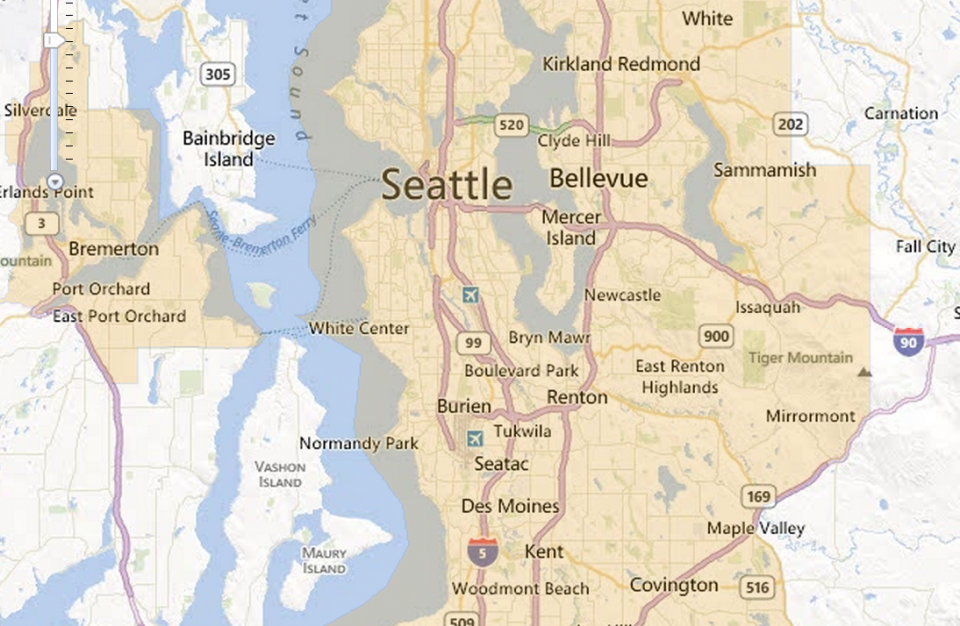
This map is as of the publishing of this post. Areas that are outside of the peachy orange shade are eligible for USDA zero down home loans.

USDA Map
 

I’m pleased to offer USDA financing as an option for borrowers who meet the criteria. If you have any questions regarding USDA or other mortgage programs for financing homes located anywhere in Washington State, please contact me, I’m happy to help!

USDA fees increasing for 2013 effective October 1, 2012

Beginning October 1, 2012, USDA will be increasing their guarantee fee and annual fee.  USDA’s guarantee fee is much like a VA funding fee or FHA upfront mortgage insurance premium: it is a lump sum that is most often financed into the loan. The annual fee, like FHA, is paid monthly as part of the mortgage payment.

The guarantee fee for purchases will remain at 2% of the loan amount. For refinances, the guarantee fee will increase from 1.5% to 2%.

The annual fee for both refinances and purchases will increase from 0.3% of the base loan amount to 0.4% effective October 1, 2012.

USDA mortgages offer zero down financing for borrowers who meet income limits and properties in designated rural areas.

NOTE: The photo in this post reflects eligible rural areas for 100% financing using a USDA zero down mortgage. If the property is not located in an orange (or peach?) shaded area, it may be eligible to purchase with a zero down mortgage.

VA Loan Limits from August 6, 2012 to December 31, 2012

VA has issued Circular 26-12-7 increasing loan limits for VA loans closed through the end of the year in the following Washington state counties:

King, Pierce and Snohomish: $498,750

San Juan: $470,000

All other counties remain at $417,000

This means that in King County, a qualified Veteran can finance a home with zero down with a sales price up to $498,750.  With that said, some lenders are still reviewing this recent change and are evaluating whether or not they will recognize the new increase or keep loan limits are their current level. 

Any sales price/loan amount above this amount is considered a “VA Jumbo”.  VA does not have a loan limit for VA jumbos, however most lenders have “overlays” limiting loan amounts for VA Jumbos.  VA Jumbos allow the Vet to buy a home with reduced down payment. A simple formula to estimate the minimum down payment required is sales price minus loan amount x 25% = minimum down payment.

Right now, as of publishing this post, I’m quoting 3.375% for a sales price of $400,000 (apr 3.557) with zero down payment. The seller can pay closing cost and prepaids up to 4% of the sales price. There is no mortgage insurance, however VA loans do have a funding fee which can be financed.

If you are selling a home, please consider buyers who are preapproved for VA financing. It’s a great program benefiting those who have served our country.