Mortgage Rates & Market Updates

Mortgage rates are influenced by economic data, inflation trends, Federal Reserve policy, and global markets — not just headlines.

In this section, I break down what’s happening in the mortgage-backed securities market and how economic reports may impact rates. You’ll find:

  • Weekly mortgage rate updates
  • Federal Reserve (FOMC) commentary
  • Inflation and employment report insights
  • Housing market trends
  • Legislative updates affecting lending

My goal is to translate complex economic movement into practical guidance for buyers and homeowners.

If you want context — not speculation — this is where you’ll find it.

The Mortgage Hot Potato: High Balance Loan Amounts

Hotpotato If you're a subscriber to my blog, then you are probably already aware that conforming loan limits are going to be reduced in late September and that banks will issue their own deadlines in advance of what Freddie, Fannie, FHA and VA have established.

Fannie Mae's FAQs state they will continue to purchase the "temporary" high balance loans as long as the note date is September 30, 2011 or earlier. Lenders will not allow that much time as being caught with a loan that exceeds what will be the new loan limits is having an unsaleable loan to Fannie or Freddie.  It's now a jumbo/non-conforming.  Banks and lenders have to provide an earlier deadline in order to not get caught with a "hot potato" which will cost them dearly with the difference in pricing and guidelines. 

The difference in interest rate for a 30 year fixed with a jumbo and high balance conforming loan amount is around 0.50 to 0.75% in rate.  This morning, a conforming high balance rate for a 30 year fixed is currently 4.625% (apr 4.735).  If a lender wound up being stuck with a "hot potato" loan that had a delayed closing and/or late delivery, and they had to sell it as a jumbo, in order to buy the rate of 4.625%, it would cost (based on current pricing) around 1.75 – 3.5% of the loan amount to buy down the jumbo rate to the note rate.  For example, if a lender is stuck with a conforming loan on a King County property in the amount of $506,001, we're talking a cost of $8,850 to $17,700 depending on the lender.  If this loan does not meet jumbo/non-conforming guidelines, such as having mid-credit scores below 720, it will cost the lender even more. 

Earlier this week, I received proof of this from one of the lenders we work with:

All loans approved and expected to close under the current loan limits must close, fund, disburse and be delivered in purchasable form no later than Friday, September 30, 2011. THERE WILL BE NO EXCEPTIONS. Please review current pipeline and new applications as there is no guarantee as to Super Conforming limits if the loan disburses after September 30th.

In order to "deliver" a loan to this lender by September 30th, a mortgage company would actually need to "close, fund and disburse" about 10 days earlier to their deadline to avoid being caught with the "hot potato".  If you have a loan amount that is in the gap between current high balance limits (which have actually always been "temporary") and the new loan limits, you need to close your transaction by mid-September to be safe.  In the greater Seattle area, this would consist of loan amounts between $506,001 and $567,500.  Here's a list of the other counties in Washington that will suffer a drop in conforming loan limits.  

By the way, this doesn't just apply to conventional loans, FHA loan limits are dropping effective October 1, 2011 too.  I have not yet received a memo from lenders we work with stating what their cut-offs are.  I expect it will be the same as conventional loans – plan on closing by mid-September or risk not being able to close.

I'll post more information as more banks and lenders issue their deadline. Meanwhile, if you are considering refinancing or buying a home and your loan amount fits into this "gap" between the existing limits, you may want to contact your local mortgage professional now if you want to avoid having a jumbo loan.

As always, I'm happy to help you if your home is located anywhere in Washington, where I am licensed.

UPDATE August 4, 2011: Another bank has issued their conforming high balance deadlines:

All loans using the ARRA loan limits must be locked on or before Thursday, September 15, 2011. These loans must be closed and funded no later than Friday, September 23, 2011.There are no further delivery requirements.

FHA Mortgage Insurance Increasing in April

NOTE: I originally published this article in February when HUD published the Mortgagee Letter. However with the increase to mortgage insurance on FHA insured loans just around the corner, I thought I should re-post this. If you are purchasing a home or refinanacing using an FHA insured loan, you will want to be in contract and have your loan application complete no later than April 13, 2011 to insure having an FHA Case Number issued in time.

Yesterday HUD issued Mortgagee Letter 11-10, making it official that FHA annual mortgage insurance will increase another 0.25% basis points on case numbers issued on or after April 18, 2011. The annual mortgage insurance is included in the monthly mortgage payment. There is no change (at this time) to the upfront mortgage insurance which is paid for at closing (typically financed or may be paid as a closing cost). This is in line with the Obama Administration's plan for reforming mortgages which was revealed on Friday.

HUDmip

Here's how this will pencil out for a 30 year fixed mortgage based on a sales price of $400,000 with a minimum down payment of 3.5% (base loan amount of $386,000).

FHA mortgages with a case number issued prior to April 18, 2011 (current as of this post):

386,000 x .90% = 3,474/12 months = $289.50.

FHA mortgages with a case number issued April 18, 2011 or later:

386,000 x 1.10 1.15% = 4,246 4,439/12 months = $353.83 $369.92

Difference in monthly payment: $64.33. $80.42

This will also impact FHA 203k rehab loans.

Remember, FHA annual mortgage insurance remains on the loan for a minimum of 60 payments regardless of loan to value. Even if a home buyer is putting down 20% towards the purchase of their Seattle area home, they will still have FHA mortgage insurance. FHA mortgage insurance will also remain on the home until the loan balance reaches 78% of the loan to value based on the original appraised value or purchase price of the home (which ever was less).

I have been originating FHA insured loans for the past eleven years at Mortgage Master Service Corporation (a Direct Endorsed HUD approved lender). I am licensed to originate mortgages for homes located in the State of Washington. If I can help you with your mortgage needs, please let me know!

Mortgage Originators should only originate mortgages

I think it’s unfortunate that the SAFE Act didn’t address having professionals who are helping people with the possible largest transaction in their life be limited to originating mortgages.  I feel quite strongly that it is NOT in a consumers best interest to use the same person to originate their mortgage AND sell them their home. [Read more…]

Adjustments to Conventional Mortgage Pricing Means Higher Rates on January 1, 2011

UPDATE DEC 19, 2013: New (more expensive) LLPA’s have been released.

UPDATE JAN 3, 2011:  Not all lenders are implementing this fee increase (yet).  This is perfect example of an advantage of working with a correspondent lender since we work with more than one bank or one banks products/rates. 

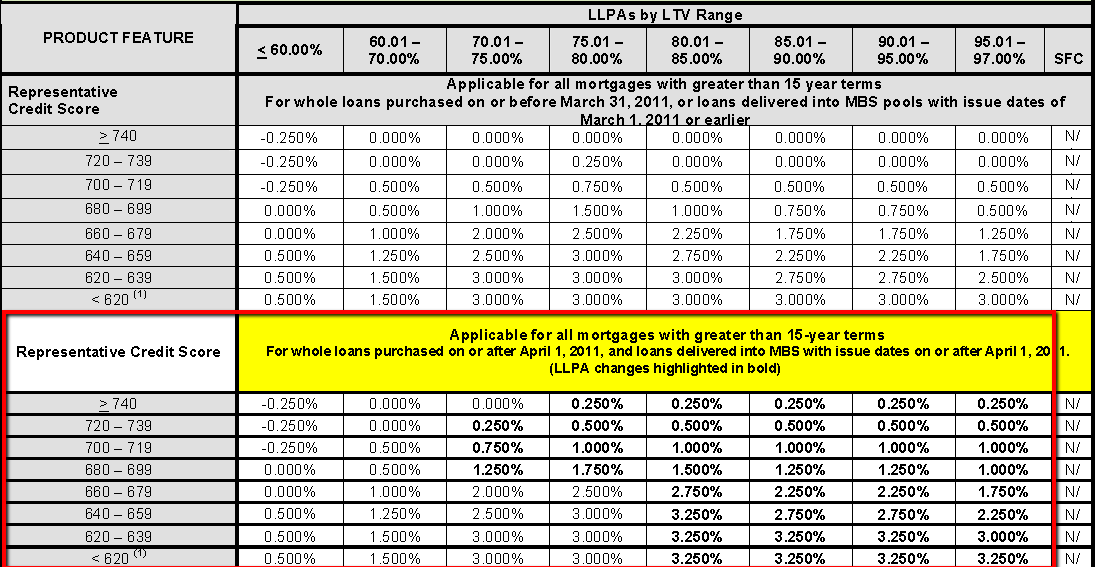
Conventional mortgages (Fannie Mae and Freddie Mac) are increasing their LLPA, also known as “Loan-Level Price Adjustment” effective on all mortgages with a term greater than 15 years on loans they purchase on April 1, 2011 or later.   Although this doesn’t go into effect until April Fools, wholesale lenders will make these adjustments to their rate sheets well in advance so that they don’t have to take the price hit when the sell the loan to Fannie or Freddie.   I am receiving memos from the lenders we work with stating that these price adjustments will go into effect on loans locked January 3, 2011.

The new price adjustments are outlined in the red box below.  The changed adjustements are in bold in the red box (click on image to enlarge).  You can view Fannie Mae’s complete LLPA schedule here – there are additional hits that may apply depending on your scenario (such as condos, subordinate financing, etc.).

FannieLLPA

LLPA’s are nothing new.  We’ve had them for the past couple of years and the adjustments are typically factored into your rate.  Remember, typically (but not always) 1% in fee equals 0.25% in rate.   So if your “low-mid” credit score is 700 – 719 and your loan to value is 75.01% or higher, your interest rate is going to be about 0.25% higher in rate than someone with a 740 or higher credit score with a loan to value of 60.01 – 75%.

The hardest hit with this adjustment is borrowers with credit scores of 699 – 640 with loan to values over 80%.   These borrowers should consider FHA insured loans for financing which do not have the same level of price hits as conventional (at this time).

The best pricing is for borrowers with credit scores 700 or higher AND a loan to value of 60% or lower.   Borrowers with a 740 or higher credit score and less than 25% down payment or home equity will now be hit with a 0.25% adjustment.

These price hits impacts loan amounts of $567,500 or lower for homes located in King, Snohomish and Pierce Counties.   For a complete list of Washington state conforming loan limits, click here.

Risk based pricing is one more reason why people who are considering a mortgage, regardless of if it’s to purchase a new home in Seattle or refinance their existing home in Bellevue, should start early with the preapproval process.  Just being one digit off on your low-mid credit score may cost you.  A qualified mortgage professional can help you make the right moves with the goal of improving  your credit score if given enough time.

If you need a mortgage for a home located in Washington State, I’m happy to help you.  I’ve been originating mortgages at Mortgage Master Service Corporation since April 2000 and I’ve been licensed since 2007 (when mortgage originator licensing was first mandated in Washington).

Condo’s Getting Spanked by Fannie

iStock_000061440694_MediumFannie Mae’s latest hits to rate will be implemented by lenders any day.  Condominiums are really getting spanked with a 0.75% add to fee if there is less than 25% home equity in the property.  This will apply to both purchases and refinances for any mortgage except those amortized 15 years or less.

If you are considering refinancing your condo, contact your local mortgage professional right away (I can help you if you’re located in Washington state)…if you’re in the process of buying a condo and are “floating” your interest rate, I highly recommend considering locking.

PS:  Cash-out refinances are also getting whammo’d by Fannie.  Don’t wait!