 Finance a backyard cottage, mother-in-law apartment, or rental unit with confidence.
Washington State’s zoning landscape has shifted significantly in recent years, making ADUs and DADUs more achievable than ever. But the right financing strategy requires understanding which loan programs apply to your situation — and how rental income, occupancy type, and property use affect what’s available to you.
I help Washington homeowners and buyers navigate ADU financing from first conversation through closing.
What Is an ADU or DADU?
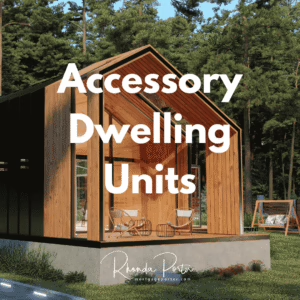
An ADU (Accessory Dwelling Unit) is a smaller, self-contained living space on the same lot as a single-family home. To qualify as an ADU, the unit must be fully habitable and include:
- A sleeping area
- A kitchen or cooking space
- A bathroom
- Its own entrance, separate from the main home
ADUs can take many forms:
- A basement or lower-level apartment
- An apartment over a garage
- A DADU (Detached Accessory Dwelling Unit) — a freestanding backyard cottage
- A converted or new manufactured home (where zoning allows)
Why ADUs Are Booming in Washington State
Recent Washington State legislation — including HB 1110 and HB 1337 — has significantly expanded where ADUs are allowed, sometimes permitting two units on a single property. Many cities have relaxed rules around parking, owner occupancy, and density to encourage more housing options.
Some municipalities are streamlining the permit process too. Renton, for example, offers pre-approved DADU plans, helping homeowners save time and money during construction. If you’re in the planning phase, coordinating financing early — before finalizing your construction plans — is one of the most valuable things you can do.
Benefits of Adding an ADU or DADU
- Increase property value by adding livable square footage
- Generate rental income — long-term or short-term
- Offset your mortgage payment with qualifying rental income
- Create flexible housing for parents, adult children, or guests
- Age in place with multigenerational living options
- Access future equity based on the after-improved value of the property
In many cases, rental income from the ADU may be used to help you qualify for the mortgage — depending on the loan program and documentation requirements.
ADUs as Family Housing — Multigenerational Living
Long before “ADU” became the planning term, homeowners called them mother-in-law apartments, in-law suites, or granny flats. The name has changed but the purpose hasn’t: creating private, comfortable space for a family member — typically an aging parent or adult child — while keeping everyone close.
In Washington State’s high-cost housing market, multigenerational living has become increasingly practical for families who want to:
- House aging parents nearby without giving up privacy for either generation
- Provide a safe, affordable living option for a family member with a disability
- Support an adult child who can’t yet afford Seattle-area rents
- Care for a family member while maintaining separate living spaces
- Share costs across generations while building long-term equity together
Unlike a rental situation, a family-use ADU often doesn’t need to generate income to justify the investment — the value is in the living arrangement itself. That said, many loan programs still consider the potential rental value of the unit when calculating the after-improved appraised value, which can work in your favor when financing.
If the arrangement involves parents helping an adult child buy, or adult children buying a home for aging parents, there are specific mortgage programs designed for exactly that scenario. See the Family Opportunity Mortgage and our guide to financing multigenerational homes.
ADU & DADU Financing Options in Washington State
There is no one-size-fits-all loan for ADUs. The right option depends on your goals, equity position, credit profile, and how the property will be used. Here’s a breakdown of the main programs:
Conventional Renovation Loans — Fannie Mae HomeStyle®
The HomeStyle® Renovation loan is one of the most flexible options for ADU financing. It allows you to purchase a property or refinance your existing home and roll the cost of ADU construction or renovation into a single mortgage, based on the after-improved value of the property once the work is complete.
- Available for primary residences, second homes, and investment properties
- Renovation funds are escrowed and released in stages as work is completed
- Requires a licensed contractor and approved renovation plan
- Based on appraised after-improved value — meaning you may be able to finance more than your current equity would suggest
- No separate construction loan needed — one loan, one closing
For investment properties, HomeStyle is one of the few renovation programs that applies — FHA 203(k) does not.
Learn more: Renovation Mortgage Guide | Renovation Refinance
FHA 203(k) Renovation Loan
The FHA 203(k) is a government-backed renovation loan that allows you to purchase or refinance a primary residence and include renovation costs in a single FHA loan.
- Lower minimum down payment (3.5% for qualified buyers)
- Flexible credit guidelines
- Available for primary residences only — not investment properties
- Full 203(k) handles structural work and larger projects; Limited 203(k) handles smaller improvements
- Based on after-improved appraised value
FHA 203(k) can be a strong option for buyers purchasing a property with ADU potential who need flexible qualification guidelines. It is not available for investment property or second home ADU projects.
Learn more: FHA Mortgage Guide
HomeStyle® vs. FHA 203(k) — Which Is Better for ADU Financing?
| Feature | HomeStyle® (Conventional) | FHA 203(k) |
|---|---|---|
| Property types | Primary, second home, investment | Primary residence only |
| Minimum down payment | 3% (with qualifying program) | 3.5% |
| Mortgage insurance | PMI (removable at 20% equity) | MIP for life of loan (most cases) |
| Credit flexibility | DU/LP dependent | More flexible |
| Luxury improvements | Allowed | Not allowed |
| Based on after-improved value | Yes | Yes |
VA Loans for ADU Financing
Eligible veterans and active-duty service members may finance ADUs using their VA loan benefit with no down payment required. VA renovation options are available for purchase and refinance scenarios, making this one of the most powerful ADU financing tools for those who qualify.
- No down payment requirement
- No monthly mortgage insurance
- VA renovation loans available for ADU construction and improvements
- Must be the veteran’s primary residence
For veterans considering multigenerational living or adding a rental unit, the VA loan can be an exceptional option. Learn more: VA Home Loan Guide
One-Time Close Construction Loans
For homeowners building a new DADU from the ground up, a one-time close construction loan (also called a construction-to-permanent loan) finances both the construction phase and the long-term mortgage in a single closing.
- One loan, one closing, one set of closing costs
- Converts to permanent financing when construction is complete
- Requires a licensed general contractor and approved construction plans
- Available in conventional and FHA versions
- Strong credit and reserves typically required
Starting the financing conversation early — before finalizing contractor bids — is especially important with construction loans, since lender requirements vary and timelines can be longer than standard mortgage transactions.
Home Equity Options — HELOC or Second Mortgage
If you have substantial equity in your current home, a HELOC or fixed-rate second mortgage can provide funds for ADU construction without touching your existing first mortgage or rate.
- HELOC: revolving line of credit, draw as needed, variable rate
- Fixed-rate second mortgage: lump sum, predictable payments
- Keeps your existing first mortgage rate intact
- Good option if you have a low first mortgage rate you don’t want to disturb
- Loan amount limited by available equity and CLTV guidelines
Learn more: HELOCs & Second Mortgages
Cash-Out Refinance
If you have significant equity, a cash-out refinance can provide ADU construction funds in a lump sum at closing. This replaces your existing mortgage with a new, larger loan and gives you the difference as cash — which you manage and deploy independently, without escrowed renovation funds or staged disbursements.
- Simpler process than renovation loans — no contractor approvals or draw schedules
- Maximum 80% LTV for conventional and FHA cash-out
- Best when you have enough equity and want full control over the construction process
- Rate and term on the new loan replaces your existing mortgage
Reverse Mortgage (for Eligible Homeowners)
For homeowners 62 or older, a reverse mortgage can provide funds to add an ADU for family housing or rental income — without monthly mortgage payments. This is a niche option but worth exploring for the right situation.
Can Rental Income from an ADU Help Me Qualify?
This is one of the most common questions — and the answer depends on the loan program and how the income is documented.
- Existing ADU with rental history: Most programs allow documented rental income (leases, tax returns, or market rent from an appraiser) to count toward qualifying income
- New ADU being built: Some programs allow projected rental income based on an appraiser’s market rent analysis, even before the unit is occupied
- HomeReady® loans: Allow accessory unit rental income to count as qualifying income even without a rental history, in some cases
- Investment property programs: For non-owner-occupied ADU scenarios, DSCR and investor loan programs may qualify based on the property’s cash flow
The right program depends on your occupancy plans, income documentation, and equity position. Running the numbers across multiple scenarios is the best way to find the most favorable path.
Occupancy Type Matters
How you plan to use the property affects which programs are available and what the down payment requirements are:
| Occupancy | Programs Available | Down Payment |
|---|---|---|
| Primary residence (owner in main home, tenant in ADU) | Conventional, FHA, VA, USDA, HomeStyle, 203(k) | As low as 0–3.5% |
| Investment property (owner does not occupy) | Conventional, HomeStyle, DSCR, portfolio/non-QM | Typically 15–25% |
| Second home with ADU | Conventional, HomeStyle | Typically 10%+ |
Learn more about financing multigenerational homes or investment property financing.
Planning Matters — Start Early
ADU projects require coordination between zoning, permitting, contractors, and financing. A few things that make the process smoother:
- Check local zoning first — confirm ADU/DADU is allowed on your property before proceeding
- Get contractor bids early — renovation and construction loans require documented cost estimates
- Start the mortgage conversation before finalizing plans — lender requirements can affect how plans are structured
- Document existing rental income if the ADU already exists and is rented — this makes qualifying easier
- Understand the after-improved value — renovation financing is based on what the property will be worth after construction, not what it’s worth today
Frequently Asked Questions
What financing options are available for ADUs and DADUs in Washington State?
Options include conventional HomeStyle renovation loans, FHA 203(k) renovation loans, VA loans for eligible veterans, one-time close construction loans, HELOCs and fixed-rate second mortgages, cash-out refinances, and reverse mortgages for eligible homeowners. The best option depends on occupancy, equity, credit profile, and project scope.
Can rental income from an ADU be used to qualify for a mortgage?
In many cases yes. Documented rental income from an existing ADU, and in some cases projected market rent for a new ADU, may be used to help qualify for the mortgage. Guidelines vary by loan program.
What is the difference between HomeStyle and FHA 203(k) for ADU financing?
HomeStyle is available for primary residences, second homes, and investment properties and allows luxury improvements. FHA 203(k) is limited to primary residences and has more flexible credit guidelines but requires FHA mortgage insurance for the life of the loan in most cases. Both are based on the after-improved appraised value of the property.
Can a VA loan be used to finance an ADU?
Yes. Eligible veterans may finance ADU construction or improvements using their VA loan benefit with no down payment required, as long as the property is their primary residence.
Does adding an ADU increase my property value?
In most cases yes. Adding livable square footage typically increases the appraised value, especially in high-demand Washington markets. Renovation financing programs that use the after-improved value may allow homeowners to access that future value as part of the financing structure.
Can an ADU be used for family housing rather than as a rental?
Absolutely — and this is one of the most common reasons Washington homeowners add an ADU. Whether it’s a mother-in-law apartment for an aging parent, a granny flat for a grandparent, or a private suite for an adult child, the family use case is just as valid as rental income. Loan programs that use the after-improved appraised value of the property still consider the unit’s market rental value for appraisal purposes, even if you don’t plan to charge rent. For arrangements involving parents and adult children buying together or for each other, the Family Opportunity Mortgage may also apply.
What are the zoning requirements for ADUs in Washington State?
Washington State has significantly expanded where ADUs are allowed through HB 1110 and HB 1337. Many cities have relaxed rules around parking, owner occupancy, and density. Local zoning and permitting requirements must still be met before financing is arranged. Some municipalities such as Renton offer pre-approved DADU plans to streamline the permitting process.
Ready to explore ADU financing for your Washington State property?
Whether you’re adding an ADU to your current home, buying a property with ADU potential, or refinancing to build or convert additional living space, I’m happy to run the numbers and help you find the right path.
Schedule a Discovery Call |
Get a Rate Quote |
Contact Rhonda
Here are articles I’ve written on mortgages for accessory dwelling units (attached and detached).
Last reviewed: July 2026